
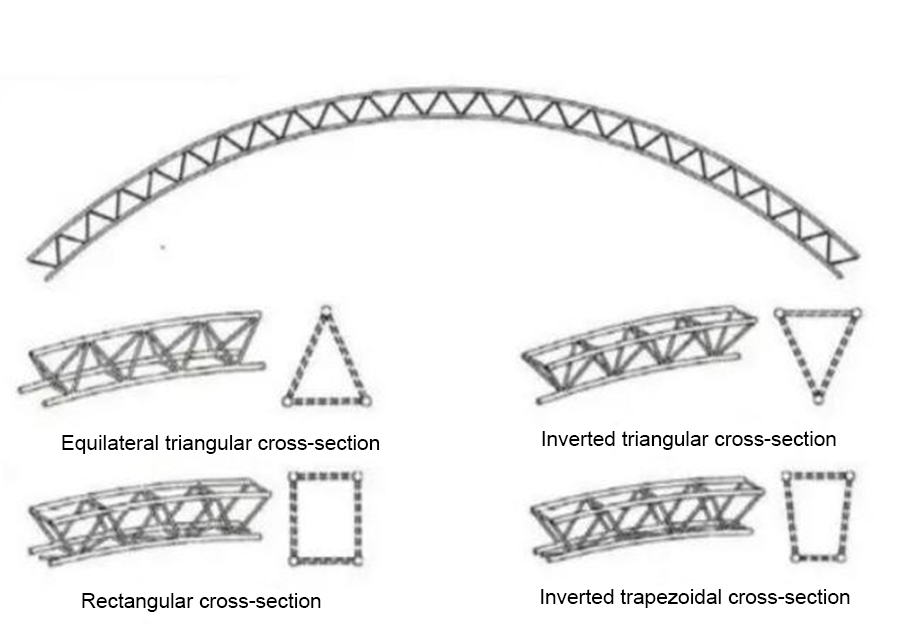
The steel truss-arch is a spatial structural form that combines the load-bearing mechanism of a truss with the geometric advantages of an arch, thereby integrating the truss's efficient load transfer characteristics with the arch's superior performance under compression. Based on cross-sectional configuration, steel-tube truss-arches are categorized into planar and spatial types.
Spatial truss-arches feature diverse cross-sections, with triangular, rectangular, and trapezoidal shapes being the most common. Among these, the triangular cross-section is preferred due to its excellent torsional rigidity and stable spatial load-bearing performance; the equilateral triangular section, in particular, allows for balanced force distribution across three directions, resulting in outstanding overall stability. Chord and web members may be constructed from circular steel tubes, rectangular steel tubes, or other structural steel shapes. The angle between diagonal web members and chords should ideally be maintained between 30° and 60° to ensure joint rigidity and efficient load transfer.
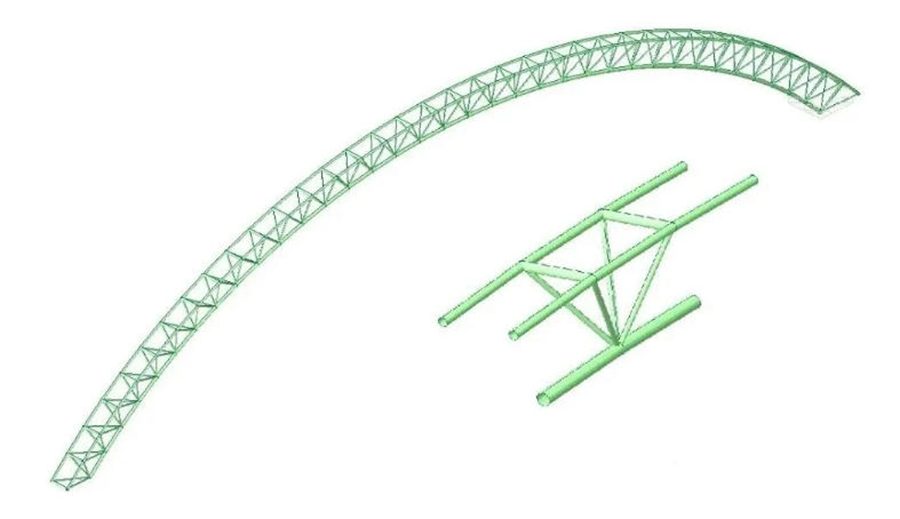
Regarding structural behavior, the truss structure essentially evolved from the simply supported beam; consequently, its internal force distribution closely mirrors that of a simply supported beam. Specifically, the internal forces in the chords follow a pattern of being highest at the mid-span and lowest at the ends,with the mid-span chords bearing the maximum bending moment effect, which gradually decreases toward the supports. Conversely, the internal forces in the web members exhibit an opposite pattern: lowest at the mid-span and highest at the ends. Web members near the supports must withstand greater shear forces, whereas those at the mid-span experience relatively lower loads. This characteristic dictates that member selection must be tailored to specific locations: mid-span chords should utilize larger cross-sections, while the design of end web members must prioritize shear-bearing capacity and joint connection strength.
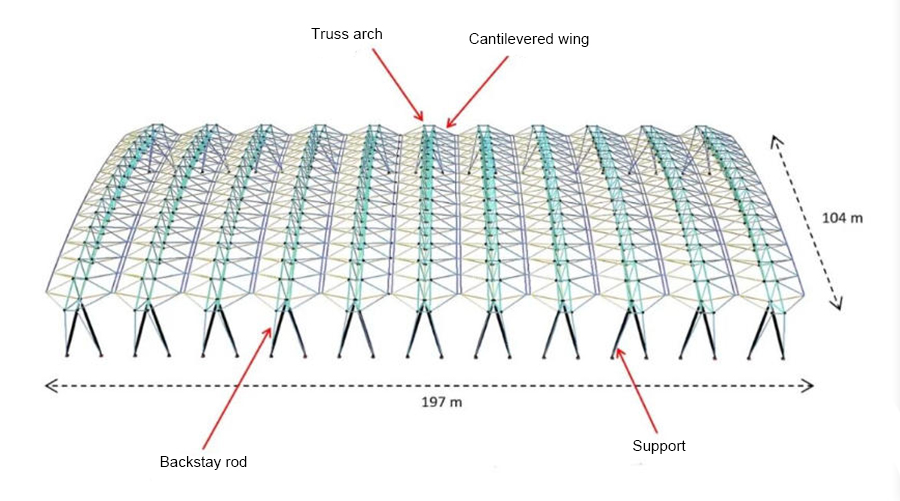
In multi-span continuous truss-arch structures, the presence of negative bending moments at intermediate supports alters the internal force distribution of the chords compared to single-span simply supported trusses. Chords located above intermediate supports may experience stress reversal or significant force increases, necessitating specific reinforcement. Design procedures require detailed cross-section verification and stability analysis for each individual member, based on actual support conditions and loading scenarios. In addition, the overall spatial stability and torsional effects of the spatial truss arch must be considered; particularly for long-span or heavy-load conditions, structural safety must be ensured through appropriate section selection and bracing arrangements.
For more information needed or any inquiry,please feel free to contact Yumisteel team.
years of experience



 online service
 +86-592-6095031
 manager@yumisteel.com
 Alina_Yuki
 +8613559086380+8615860744964
 English
 русский
 español
 português
 日本語
日本語