
Many newcomers assume roof purlins and wall purlins are basically the same thing.After all, they're both called purlins. But their design logic, load paths, and detailing requirements are completely different. Let me break it down clearly with a table.
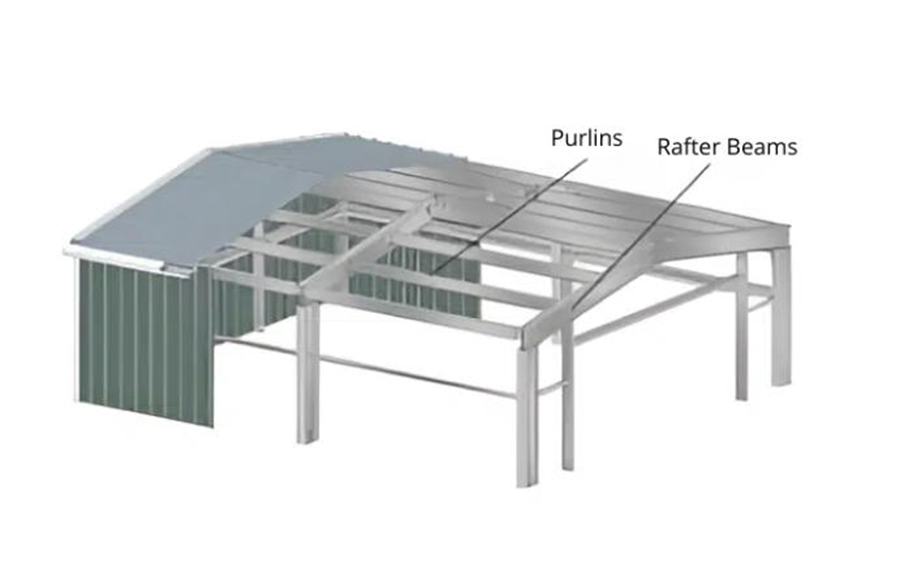
☆ Core difference: one resists 'gravity', the other resists 'wind'
|
Comparison |
Roof Purlins |
Wall Purlins |
|
Dominant load |
Vertical loads (snow, self-weight, construction loads) |
Horizontal wind loads (pressure / suction) |
|
Load behavior |
Mainly load-bearing; lower flange can buckle under wind uplift |
Resists bending and shear; controls horizontal forces |
|
Typical scenarios |
Snow load, wind uplift |
Wind pressure & suction |
☆ Section selection: one needs heavier sections, the other can be lighter
|
Comparison |
Roof Purlins |
Wall Purlins |
|
Common sections |
C, Z (light & economic; Z allows lapping for continuous beams), high-frequency welded H-section (for large spans) |
Mostly C-section (easy to connect wall panels); H-section for large spans / high wind pressure |
|
Selection logic |
The larger the span or snow load, the taller the section and thicker the web |
Wind pressure zones determine spacing and section; generally smaller than roof purlins |
Key tip: Z-section is more economical than C-section for roof purlins because Z-purlins can be lapped at supports (lap length ≥10% of span with proper bolting) to form a continuous beam. Under ideal lapping conditions, the moment can be reduced by 30–40% compared to simple-span purlins. In real projects, considering joint slip, a reduction of 10–20% is typically used for conservative design.
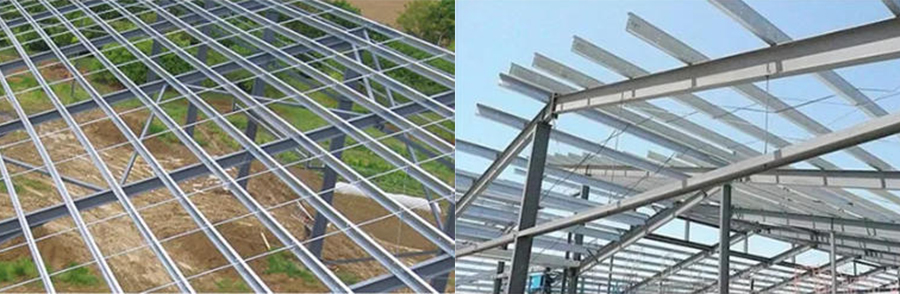
☆ Key details: roof needs 'double ties', walls need 'columns'
|
Comparison |
Roof Purlins |
Wall Purlins |
|
Critical detailing |
Double row of sag rods (top & bottom flanges), plus knee braces (connect beam lower flange to purlin) |
Single row of sag rods + wall column cooperation + opening reinforcement |
|
Why |
Under wind uplift, the lower flange is in compression; without lower sag rods, it’s like lifting a bent person – prone to buckling |
Large wall areas subject to wind need wall columns to share loads; openings are weak spots requiring denser members |
☆Different design check priorities
|
Comparison |
Roof Purlins |
Wall Purlins |
|
Key checks |
Overall stability under wind uplift (lower flange) + vertical deflection |
Strength & stability under horizontal wind loads + horizontal deflection |
|
Deflection limits |
Vertical: L/150 (no ceiling), L/200 (with ceiling) |
Horizontal: generally L/150 (can be tightened to L/200 for special requirements) |
☆Installation sequence: roof first, then walls
Correct order: install roof purlins first to form a stable space frame, then install wall purlins. Wall purlins rely on the roof purlin system to create an integral wind-resistant system.
☆One-table summary
|
Comparison |
Roof Purlins |
Wall Purlins |
|
Primary load |
Vertical (snow, self-weight) |
Horizontal (wind pressure) |
|
Common sections |
Z, C, H |
Mostly C |
|
Critical details |
Double sag rods, knee braces |
Single sag rods, wall columns, opening reinforcement |
|
Design focus |
Uplift stability, vertical deflection |
Strength, horizontal deflection |
|
Deflection control |
Vertical: L/150 (no ceiling), L/200 (ceiling) |
Horizontal: L/150 |
|
Corrosion protection |
Both require hot-dip galvanizing ≥65μm in humid/corrosive environments |
Both require hot-dip galvanizing ≥65μm in humid/corrosive environments |
|
Installation order |
First |
Later |
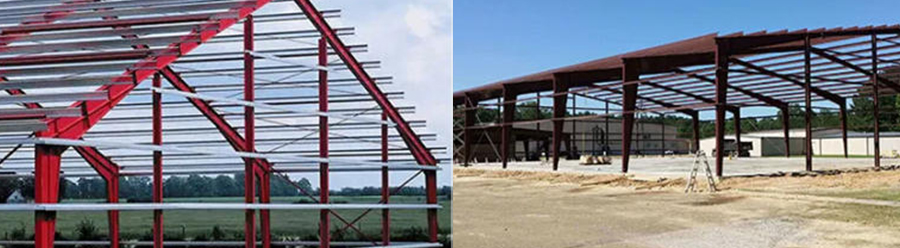
In short, while roof purlins and wall purlins appear similar, their load transfer mechanisms, sectional profiles, and construction details differ entirely. A solid grasp of these distinctions ensures error‑free design and smooth installation.
For more information needed or any inquiry,please feel free to contact Yumisteel team.
years of experience



 online service
 +86-592-6095031
 manager@yumisteel.com
 Alina_Yuki
 +8613559086380+8615860744964
 English
 русский
 español
 português
 日本語
日本語